
How to Check Criminal History in Sumter County
No single screen holds every Sumter County criminal record. Begin with the South Carolina Judicial Branch Public Index for a filed criminal case. Select Sumter County and the right court agency, then search by a full name or exact case number. Use the county clerk when an older file, signed order, or certified disposition is not shown as an image. A recent arrest may not have reached the court yet, so the arresting agency and Detention line remain separate checks.
Use SLED CATCH when the goal is the statewide repository view. It is a name and date-of-birth search, not a fingerprint identity match. A person reviewing their own Sumter County criminal history should compare each CATCH cycle with the Public Index disposition. SCDC covers current state prisoners, while SCDPPPS handles public state supervision information. These tools answer different questions.
- Search the Public Index with Sumter selected and save the court agency and case number.
- Read each count, event, disposition, and disposition date rather than relying on the overall status.
- Call the correct clerk for missing images, older files, or a certified court record.
- Contact Sheriff Records or City of Sumter for the source incident report and Detention for current custody.
- Compare the court result with CATCH, SCDC, or SCDPPPS only when that state layer fits the question.
Sumter County Court Record Routes
Choosing the court is the first local test. General Sessions at the Sumter County Judicial Center keeps felony and other serious criminal files. Sumter Magistrate Court handles county summary matters. Municipal cases stay with Sumter, Mayesville, or Pinewood Municipal Court unless the case moves under an authorized transfer or serious charges proceed in General Sessions. A broad Sumter County criminal record search can miss a town case when the wrong court agency is selected.
The Public Index supports searches by county, court agency, case number, party name, filing dates, case type, and status. Search results can show the charge, events, financial or bond entries, hearings, and outcome, but the presence of metadata does not guarantee a downloadable pleading. Ask the clerk for a signed order or certified disposition when the screen is not enough.
| Channel | Best Starting Detail | Record Layer |
|---|---|---|
| Public Index | Court agency, exact name, or case number | Docket, charges, events, disposition |
| General Sessions clerk | Case number and requested document | Certified or archived court file |
| Sheriff or city records | Incident number, date, and place | Source incident or arrest report |
| SLED CATCH | Legal name and date of birth | State repository history |
The SLED Criminal Justice Information Services page shows how arrest and disposition data reach the state repository.
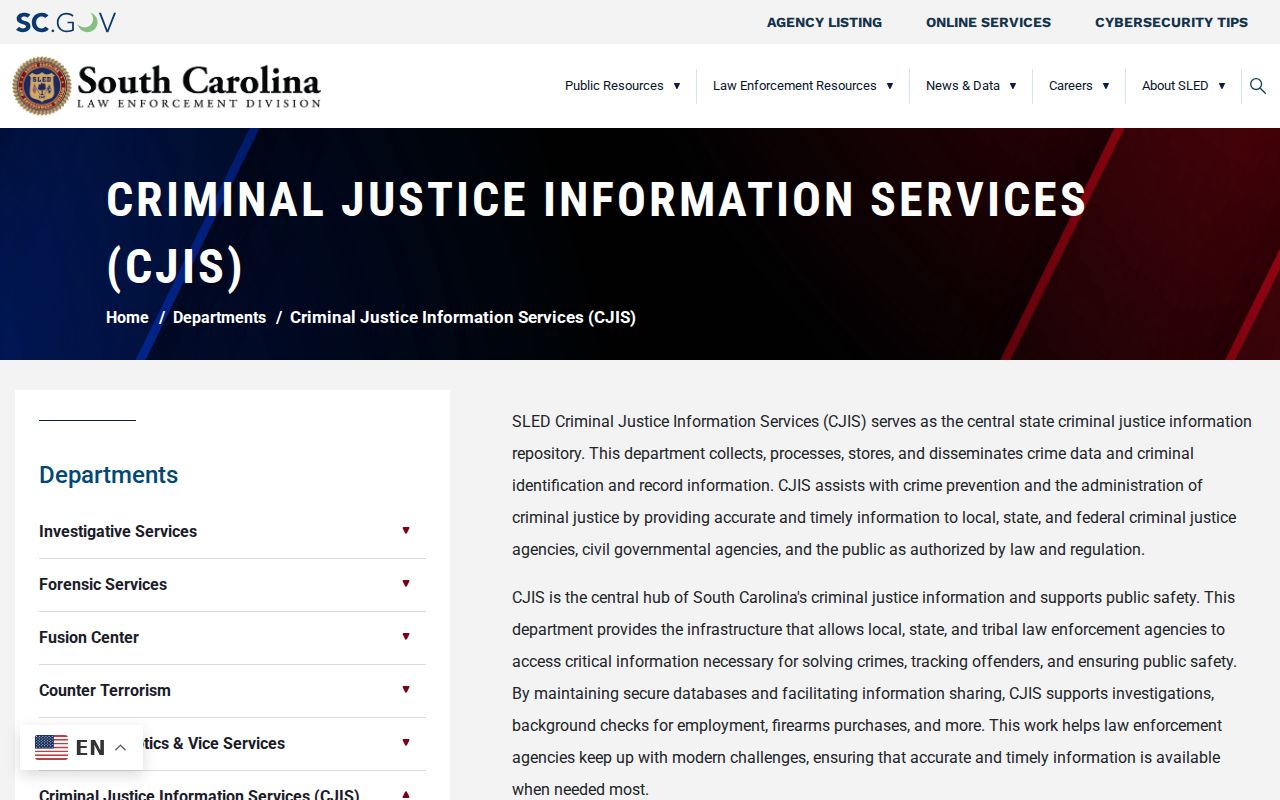
That state workflow explains why the court file and CATCH report should be checked together.
Official South Carolina Background Checks
SLED CATCH is South Carolina's ordinary public name-based criminal history product. The report fee is $25, plus the transaction charge shown at checkout. SLED announced a $1.43 service fee for each $25 report effective July 1, 2026, so a reader should confirm the live total before paying. Mail requests use the official form, accepted payment, a self-addressed stamped envelope, and the SLED Records Department address in Columbia. Certification or notarization must be requested.
CATCH can return a wrong match or miss a record when names, aliases, or dates of birth vary. It also does not search the sex offender registry. For a subject-only national self-review, the FBI Identity History Summary uses current fingerprints and costs $18 before any capture or channeler fee. The FBI explains fingerprints, responses, and challenges in its official FAQ. The request begins through the FBI electronic order portal. SLED does not publish one universal Sumter storefront for an ordinary state self-review, so contact CJIS about the right fingerprint process.
| Official Product | Basis and Reach | Published Price |
|---|---|---|
| SLED CATCH | Name and date of birth; South Carolina repository | $25 plus live online charge |
| Sumter Public Index | Party or case search; local court dockets | Free search |
| Agency records request | Incident, arrest, or booking source record | Local fee not located |
| FBI Identity History Summary | Fingerprints; subject's own national history | $18 plus capture costs |
The official FBI electronic order portal is the starting point for a fingerprint-based personal identity history request.
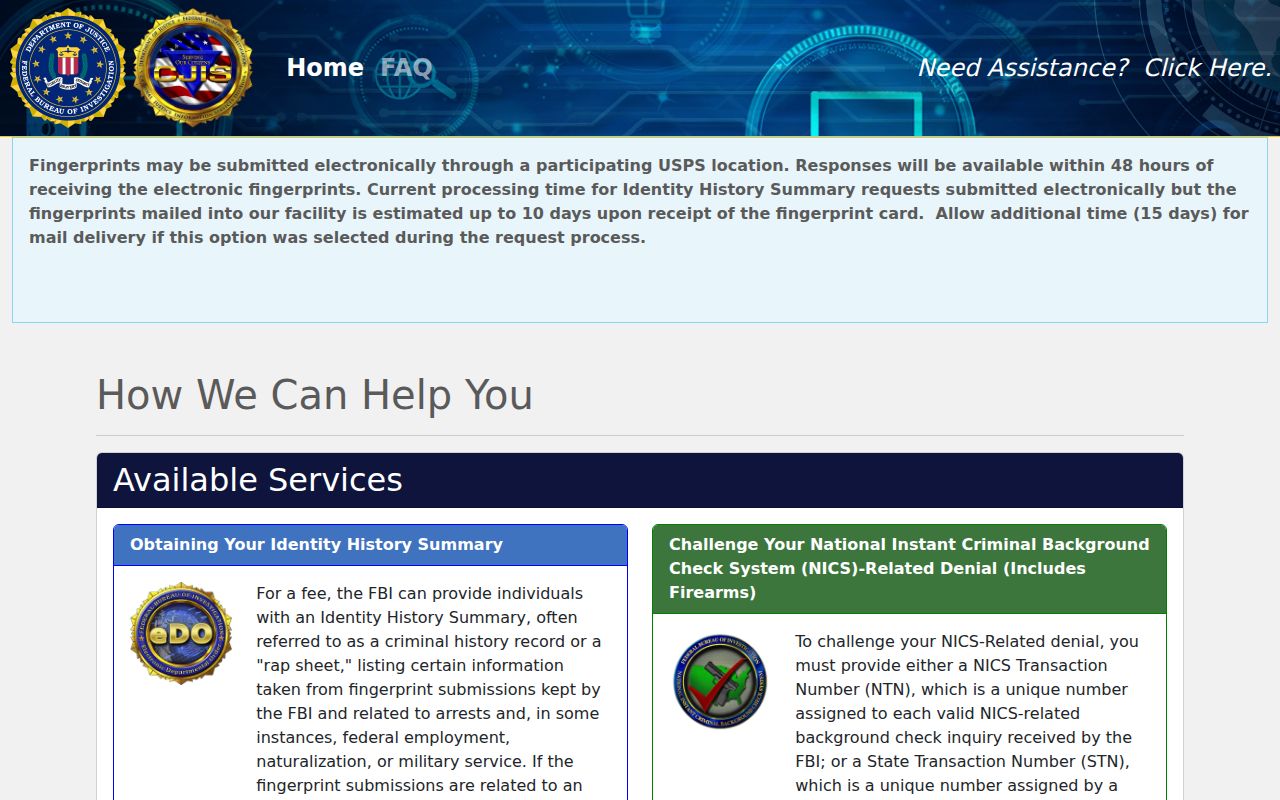
This federal result is a different product from a Sumter County court docket or sheriff report.
SLED CATCH for Sumter Records
CATCH requires acceptance of its terms before the query form opens. The core search uses last name, first name, and date of birth. A middle name or initial can narrow a common-name result. The public query is paid and name based even though fingerprints support the state repository beneath it. Save the report and note the search data used, since even a small name difference can alter the result.
| Field or Control | Use | Key Point |
|---|---|---|
| Terms acceptance | Required gateway | Read and accept before searching |
| Last and first name | Required identity fields | Use legal spelling and test known variants |
| Middle name or initial | Optional filter | Helps separate common names |
| Date of birth | Required match field | An error can cause a false result |
| Payment | Completes the request | Review the current service charge |
The official CATCH entry page displays the current terms, cost notice, and statewide search route.
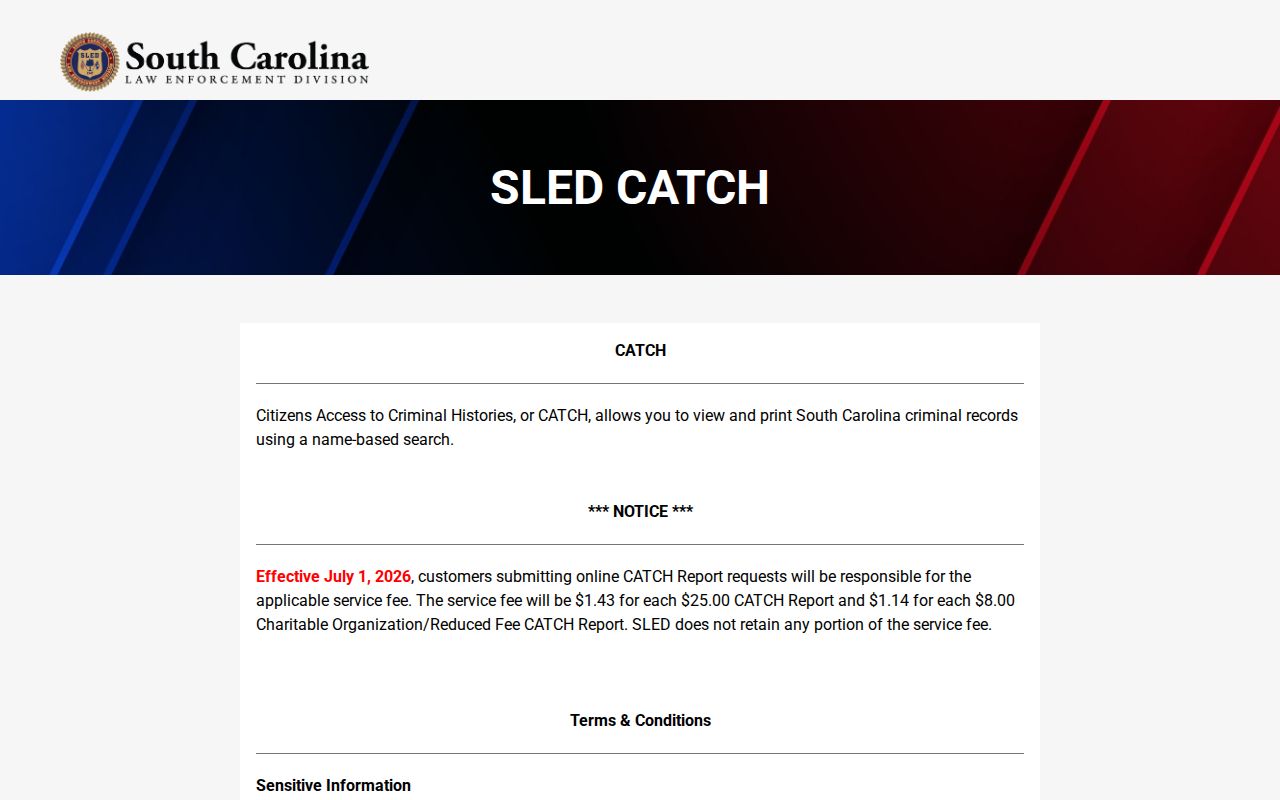
CATCH adds a state repository view, but it does not replace the Sumter County case file.
Types of Criminal Records
Sumter County criminal records are split by purpose and custodian. An incident report describes what an agency received or investigated. A booking record marks detention intake and initial charges. A court case file tracks filed charges and the final result. A CCH record joins fingerprint-supported arrest cycles to reported dispositions. Custody and registry systems answer still other questions.
- Incident and arrest reports: held by the sheriff, Sumter Police, or the agency that made the arrest.
- Booking records: created at detention intake and confirmed through the county detention operation.
- Court case files: held by General Sessions, Magistrate, Bond, or the municipal court that heard the matter.
- State criminal history: assembled by SLED from supported arrest and disposition reports.
- Custody and supervision: split among county detention, SCDC, and SCDPPPS.
- Registry records: published through SLED SORT and updated with county sheriffs.
These records may describe the same event with different words because charges can change between intake, prosecution, and judgment. An arrest is not a conviction. South Carolina also classifies many offenses in six felony and three misdemeanor classes, while exempt offenses carry their own punishment. General Sessions normally handles felony and serious misdemeanor charges. Municipal jurisdiction is generally limited to ordinances and qualifying offenses within its statutory ceiling, and an authorized transfer can move an eligible matter. Read the charged statute and final count rather than inferring the outcome from a class label.
Sumter County Sheriff Record Fallback
The Sumter County Sheriff's Office is the practical fallback when no public portal answers the question. Sheriff Records is at 1281 North Main Street in Sumter and can be reached at 803-436-2028. Use that office for sheriff-created incident and arrest reports, local warrant-record questions, and historical booking questions. Call Detention at 803-436-2343 for current custody confirmation. Ask about the current form, fee estimate, identification rule, and delivery method before sending payment. No reliable official online jail roster for Sumter County, South Carolina was found. Search results can lead to a polished Sumter County jail portal in Florida. Do not use it for South Carolina records. Start with the sheriff and court phone lines instead, and narrow a South Carolina FOIA request by incident number, date, place, agency, and record type.
Warrant checks use the same fallback logic because Sumter County has no verified public countywide warrant portal. Call Sheriff Records for sheriff-held information. Bond or Magistrate Court uses 803-436-2280, while the General Sessions clerk uses 803-436-2227. A bench warrant can be tied to a specific court, so Mayesville and Pinewood matters should also be checked with their municipal clerks. Public Index may reveal a related case, but a blank result cannot rule out a new, sealed, or unserved warrant. Contact the issuing court and counsel for lawful appearance or bond instructions.
Sumter Sheriff Records
1281 North Main Street
Sumter, SC 29153
803-436-2028
General Sessions Clerk
215 North Harvin Street
Sumter, SC 29150
803-436-2227
Bond and Summary Courts
Bond: 190 East Canal Street
Magistrate: 115 North Harvin Street
803-436-2280
The official South Carolina Sheriffs' Association directory confirms the Sumter County sheriff, records, detention, patrol, and investigations contacts.
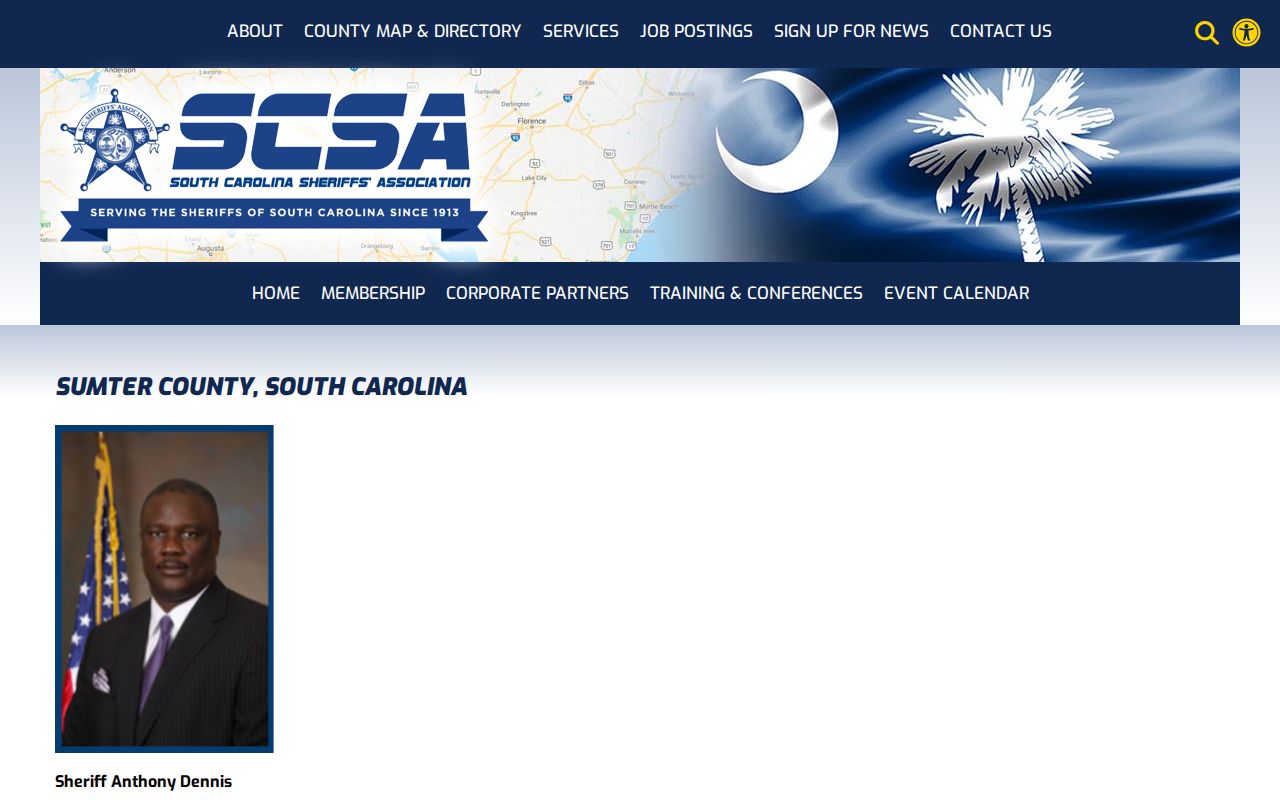
The directory is the source to use when an unofficial roster or stale number appears in search results.
What a Sumter County Criminal Record Shows
The fields depend on the record layer. A Sumter County case entry centers on a court and case number. A booking record centers on custody intake. SLED organizes the state criminal history around identity and fingerprint-supported arrest cycles. Compare the identifiers, charge wording, and dates before treating two entries as the same event.
| Name and Identifiers | Legal name, aliases, descriptors, and state or FBI identifiers where lawfully released. |
|---|---|
| Arrest and Booking | Agency, date, fingerprint transaction, intake charge, custody time, bond, and release data. |
| Charges and Statutes | Initial allegation, filed or amended count, offense description, and statutory citation. |
| Disposition | Outcome for each count, such as conviction, dismissal, acquittal, or nolle prosequi. |
| Sentence | Court-ordered incarceration, probation, financial terms, restitution, or other public conditions. |
| Custody or Supervision | Current jail, SCDC, probation, parole, or other public status when the proper system covers it. |
- Disposition
- The result entered for a charge or count.
- Nolle prosequi
- A prosecutor's formal choice not to proceed at that time.
- General Sessions
- The criminal side of Circuit Court for serious South Carolina cases.
- Summary court
- A magistrate or municipal court with limited criminal jurisdiction.
Matching the court agency and case number is safer than assuming that similar names or charge labels refer to one Sumter County matter.
Sumter County Custody and Supervision
County detention, state prison, and community supervision are not one record system. Detention confirms current local custody before trial or for county-held matters. SCDC's Incarcerated Inmate Search covers people currently sentenced to and incarcerated in the state prison system, with data current as of the prior midnight. It excludes released people, county-only detention, juveniles, and probation or parole-only cases. SCDPPPS runs probation and parole for Sumter County from 20 North Magnolia Street. On July 28, 2026, its official county block listed 617 probation cases, 31 parole cases, 50 community supervision cases, 21 supervised reentry cases, and 29 Jessie's Law tracking cases. Those figures measure a supervision workload, not crimes or unique incidents.
The official Sumter supervision office page provides the local contact and dated jurisdiction counts.
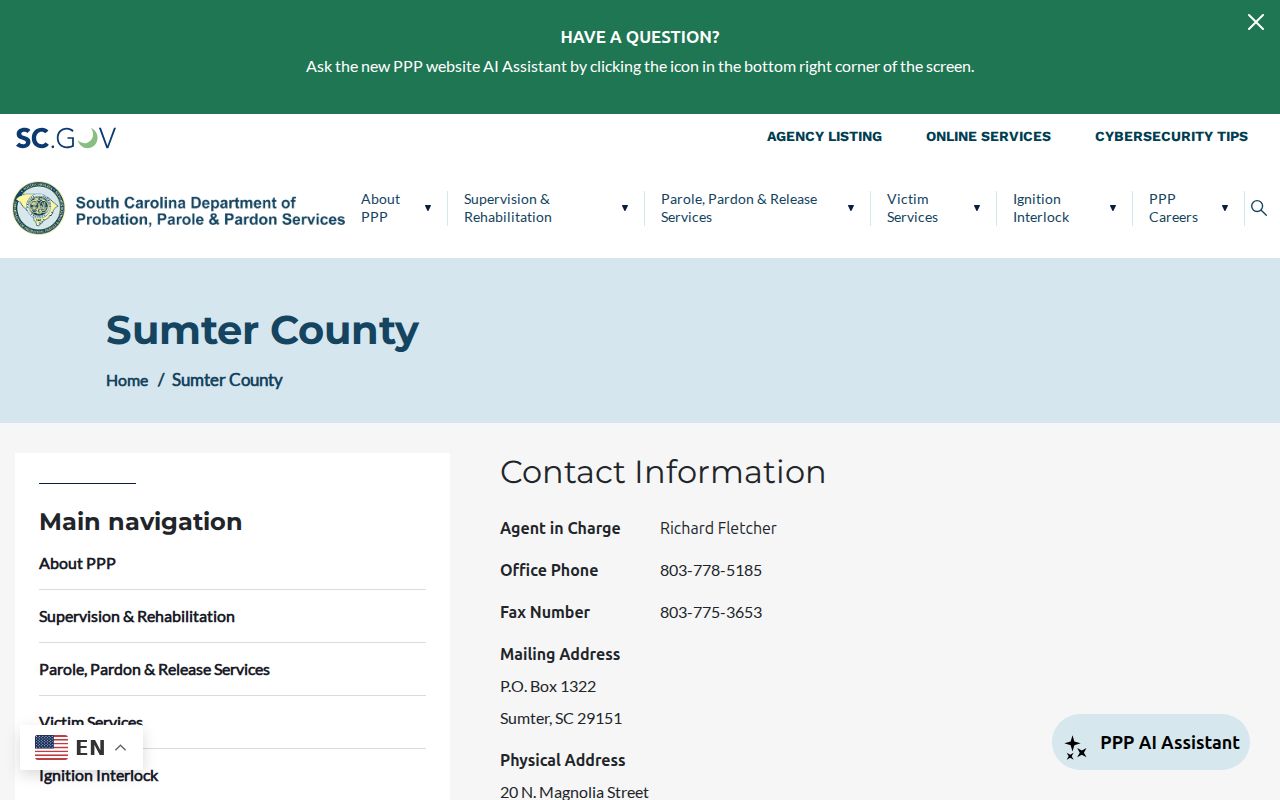
The county block helps separate active state supervision from jail or prison custody. The SCDPPPS homepage supplies the offender search and Board of Paroles and Pardons routes.
Use a court judgment to verify the sentence before relying on a current supervision status.
Public Access Laws
The South Carolina Freedom of Information Act allows inspection, copying, or electronic delivery of public records, subject to exemptions and reasonable agency rules. A Sumter County request can still be redacted for an active investigation, protected victim data, confidential sources, juvenile information, personal identifiers, or other closed material. Ask for segregable public portions when only part of a report is exempt.
Key authorities:
S.C. Code §30-4-30 permits inspection, copies, and electronic transmission of public records, subject to lawful limits.
S.C. Code §30-4-40 identifies records and details an agency may withhold or redact.
S.C. Code §23-3-120 governs required arrest fingerprint submissions that support SLED history records.
Rule 41.2, SCRCP requires sensitive identifiers to be removed from public electronic court images.
S.C. Code §17-22-910 supplies an expungement route for listed eligible outcomes and offenses.
The official South Carolina FOIA text is the controlling source for access and exemptions.
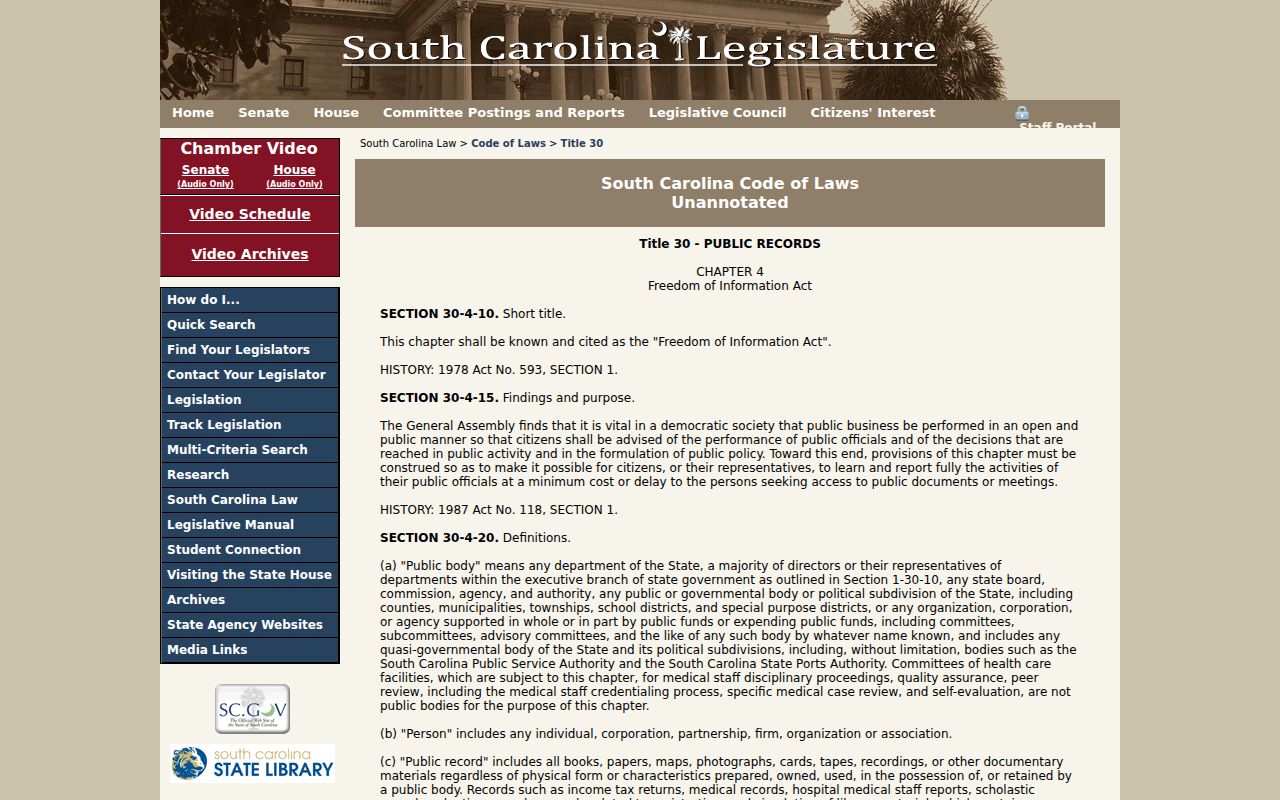
The statute supports a narrow, well-described request rather than a demand for every record tied to a name.
Recent Sumter City Crime Records
City of Sumter records use a city process, not the sheriff's request route. Written requests may go in person, by mail, or by email through City Hall at 21 North Main Street. The city says its suggested form is optional and posts a ten-working-day initial response rule. A request should name the incident, date range, location, department, desired format, and fee-estimate limit.
South Carolina law and the city's published guidance give recent records a useful shortcut. Basic reports describing the nature, place, and substance of crimes from the prior 14 days, along with records identifying confinement during the prior three months, may be inspected without a written request unless an exemption applies. Juvenile and protected details remain restricted. Older narratives, supplements, audio, video, and other material should be requested with care.
Note: A city police report, a county booking record, and a Sumter County court disposition remain three separate records.
Sealed, Expunged & Restricted
Juvenile records, expunged records, sealed matters, victim or minor identifiers, and sensitive personal details do not belong in an ordinary public search. An empty Sumter County result does not prove that no protected file exists. It may also mean the wrong court was searched or the record has not reached the next system.
For a General Sessions charge, the Sumter expungement process begins with the Third Circuit Solicitor in the county of arrest. A dismissed magistrate or municipal charge goes to the summary court that handled it. SLED cannot start expungement and will not remove a charge without an Order for Destruction of Arrest Records. Eligibility depends on the exact outcome, offense, prior history, and current law.
Keep a certified copy of the signed order. SLED advises allowing four weeks after it receives an order before checking CATCH. If the entry remains, its published route calls for a certified true copy of the order, a recently purchased CATCH report, and a self-addressed stamped envelope. The South Carolina intervention and expungement law sets the legal routes and limits.
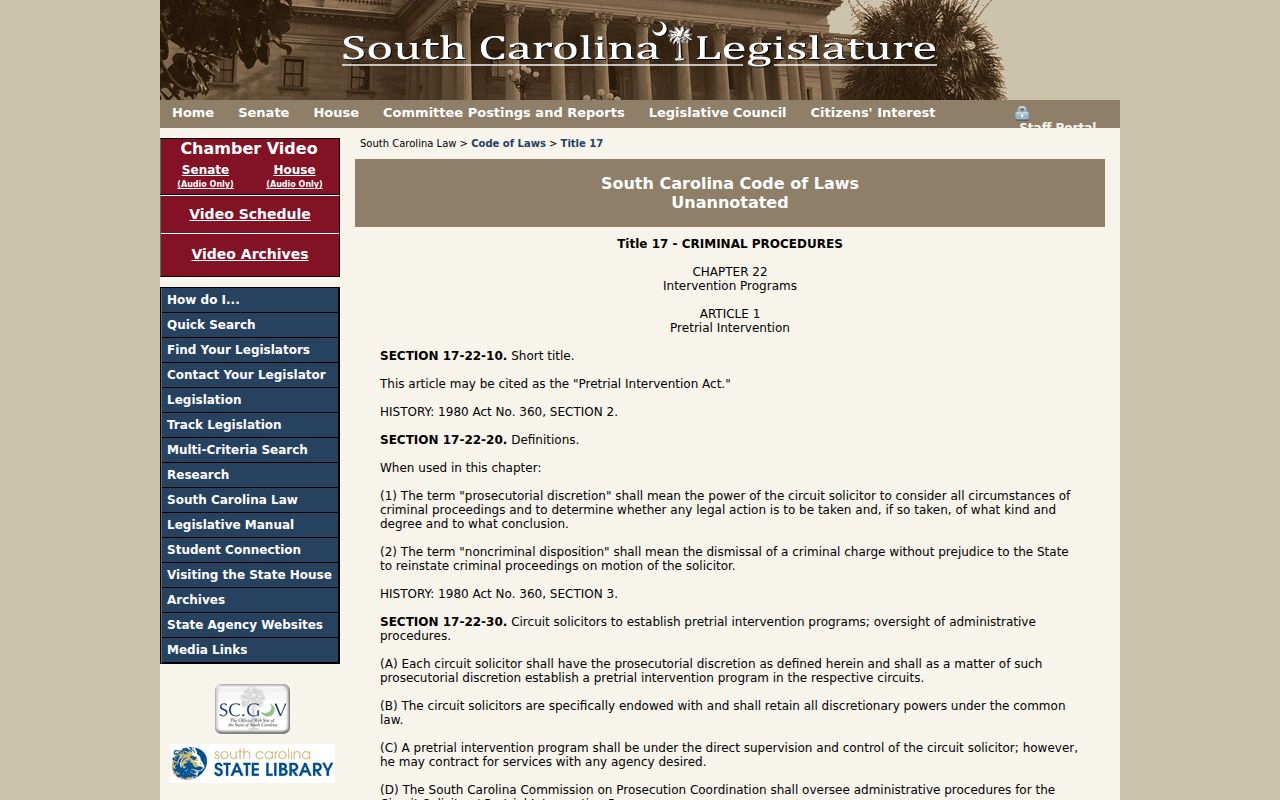
The law must be checked against each charge because time alone does not make every conviction eligible.
Federal Records Beyond Sumter County
Shaw Air Force Base and Sumter County's location add a federal layer that the county clerk does not hold. Federal criminal cases for Sumter route through the Columbia division of the U.S. District Court for the District of South Carolina. Those case numbers begin with division code 3 and use CR for criminal matters. PACER holds federal docket information, while the Federal Bureau of Prisons locator covers federal custody.
This division matters when installation security, a federal agency, or a U.S. prosecutor handled the event. A local Public Index search will not replace PACER. Federal warrants can also be sealed and do not form a public county warrant list.
The official Columbia courthouse page confirms the federal court serving the Sumter area.
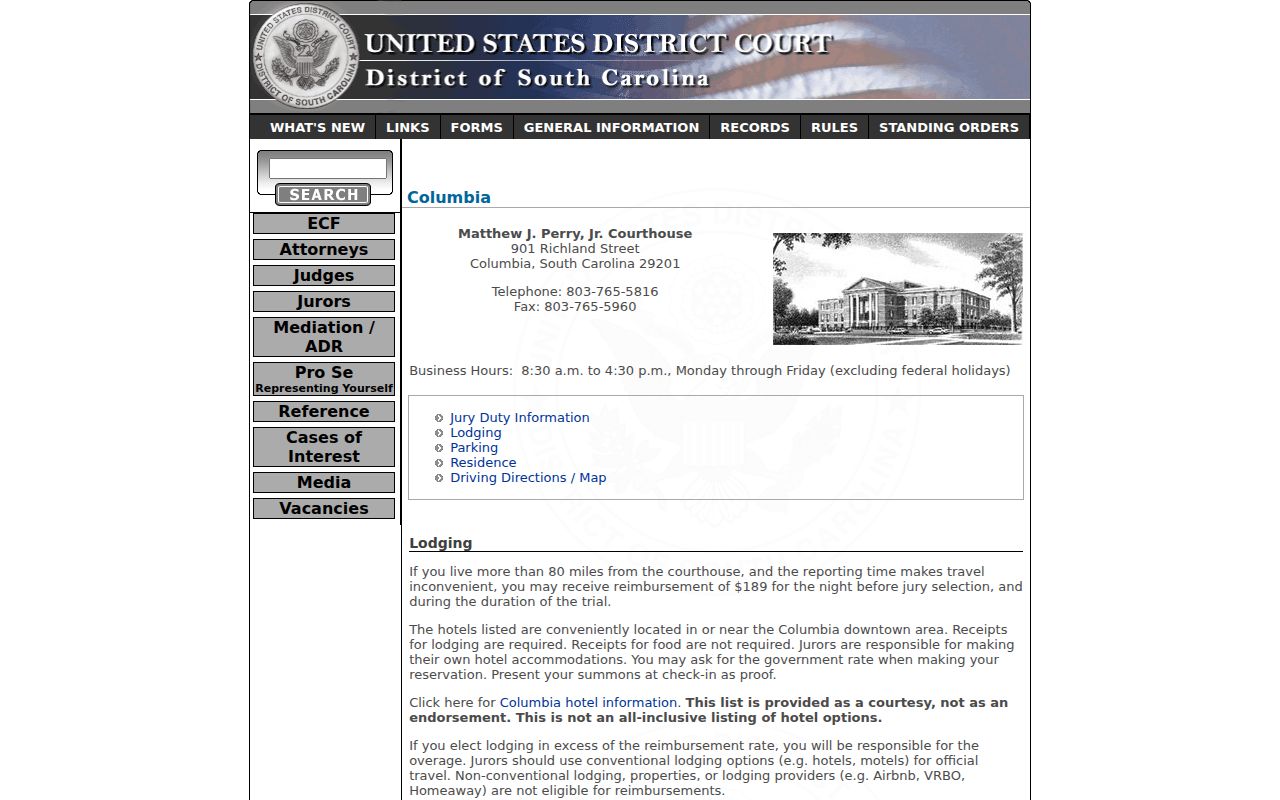
The Columbia location is separate from the Sumter County Judicial Center and its state case files.
Criminal Records by City in Sumter County
The three incorporated places have different access paths. The official Census profile for Sumter County supplies county context, while the incorporated-place table fixes the city order. Sumter city has its own police FOIA process and municipal court. Mayesville relies on the Sumter County Sheriff for policing but keeps a municipal docket. Pinewood has a verified municipal court contact, while its police records channel must be identified from the issuing agency. These city guides preserve that local split.
Sumter Criminal History
43,463 in the 2020 Census. City police records and Municipal Court use distinct local channels.
Mayesville Criminal History
548 in the 2020 Census. Sheriff policing pairs with the town's municipal docket.
Pinewood Criminal History
538 in the 2020 Census. Start with Municipal Court, then identify the arresting agency.
Fixing Sumter County Record Gaps
A missing or conflicting entry should be traced to its source. First obtain the exact Sumter County case number and count-level disposition. Then ask the clerk for the signed or certified order. Compare the arrest name, date, charge, and fingerprint-supported cycle in CATCH. A dismissal on the court screen may not yet appear in SLED if the disposition did not match or has not been processed.
SLED has highlighted the importance of fingerprints in linking an arrest to a criminal history cycle. An arrest that was never printed or transmitted can fail to match. Name-based searching adds another risk. Submit the supporting court document through the SLED correction route instead of assuming the court or state screen is complete. If an expungement order is involved, follow the specific post-order process.
Note: The best proof of a Sumter County case outcome is the signed court record, not a booking charge or search-result label.